


Under the EU Medical Device Regulation (EU) 2017/745 (MDR), every manufacturer has to show that a device conforms to the regulation before it can be placed on the market. For most devices in Class IIa and above (custom-made devices excepted), that means a Notified Body has to assess the technical documentation. How long that takes depends heavily on the quality of what you submit.
BSI, one of Europe’s largest Notified Bodies, has published best-practice guidelines for MDR documentation submissions. This article summarises the key points so that regulatory, quality and R&D teams can prepare files that move through review faster.

Why technical documentation reviews get delayed
According to BSI, two problems cause most of the delays:
- Incomplete submissions: the reviewer has not received all the information needed to carry out the assessment.
- Poorly structured documentation: the evidence is in the file, but it is hard to find.
Both are entirely within the manufacturer’s control. Fixing them shortens initial approvals, substantial change approvals and renewals alike.

Combined MDR and UKCA submissions: if you are applying for both at the same time, also include the draft UKCA Declaration of Conformity, IFU and labelling, details of your UK Responsible Person, the UK designated standards applied, a UKCA Essential Requirements checklist and the UKCA device classification.
What every submission needs
Every technical documentation review needs three things: context (what is being requested and why), the technical documentation itself (objective evidence of compliance) and authorisation for the Notified Body to do the work. In practice, that translates into four components.
1. A cover letter with an executive summary

- Certificate reference numbers, if known.
- The type of review: new product, design change, shelf-life extension and so on.
- A brief product description, including the model numbers involved.
- Reference numbers of any related or concurrent submissions that could affect this one.
- An explanation of what has been submitted and how it shows compliance, when and where the device was previously assessed, and, for changes, what is affected and what is not (with justification).
2. The technical documentation

For initial MDR approvals, a complete submission is required even if the device was previously certified under the old Directives (MDD or AIMDD). Use the Notified Body’s completeness checklist as your guide. Make each submission stand-alone: if it relies on evidence reviewed before, include the actual report rather than pointing the reviewer to an earlier file. That saves time spent finding the report, confirming it is the right version and checking whether it still applies.
3. Authorisation for the work
Work cannot start until a signed, approved quote is in place.
4. A Change Notification Form (for changes)
If you are changing a device covered by a valid certificate, or if a significant change occurs while an application is already under review, include a completed Change Notification Form.
How to submit

The preferred route is the Notified Body’s secure electronic client portal. Documents sent by other means have to be uploaded manually by administrative staff, which adds time and cost. Hard copies are not accepted.
Document format: make the reviewer’s job easy

- Language: all technical documentation and test results must be in English (exceptions may apply when transferring from another Notified Body).
- File type: paginated, fully searchable, bookmarked PDFs. Other formats have to be converted, which adds time and cost.
- One PDF per part: submit one file for each part of the documentation (see the table below). If a part is too large, split it into the smallest number of logical sub-sections.
- Avoid: password-protected or locked PDFs, zip files (especially nested ones), large numbers of separate PDFs and low-quality scans.
- Searchable text: run OCR on anything scanned from paper; non-searchable files will be converted at extra review time.
- Bookmarks: at minimum, bookmark every MDR Annex II section and all supporting attachments. Clean up the random bookmarks PDF converters often create.
- Logical file names: name files after their contents and cross-reference them in the completeness checklist.
- Signatures and approvals: use digital signatures, scanned signature pages or a marker page. Every protocol and report that needs approval (except the Declaration of Conformity) must show evidence of that approval.
Recommended structure of the technical file
| Part | Content | MDR reference |
|---|---|---|
| A | Device description and specifications, including variants and accessories | Annex II, Section 1 |
| B | Information to be supplied by the manufacturer | Annex II, Section 2 |
| C | Design and manufacturing information | Annex II, Section 3 |
| D | General safety and performance requirements (GSPRs) | Annex II, Section 4 |
| E | Benefit-risk analysis and risk management | Annex II, Section 5 |
| F | Pre-clinical information (split into sub-sections if large) | Annex II, Sections 6.1.a, 6.1.b, 6.2.d, 6.2.f |
| G | Clinical evaluation, PMS and PMCF | Annex II, Sections 6.1.c, 6.1.d; Annex III |
| H | Medicinal substances, animal/human tissue derivatives, and substances absorbed by the body (Rule 21 devices) | Annex II, Sections 6.2.a–6.2.c |
| I | Sterilisation and reusable surgical instruments | Annex II, Section 6.2.e |
| J | Declaration of Conformity | Annex IV |
| K | Class III implantables and Class IIb active devices delivering or removing medicinal substances (Rule 12), for the CECP process | Article 54 |
The submission and review process
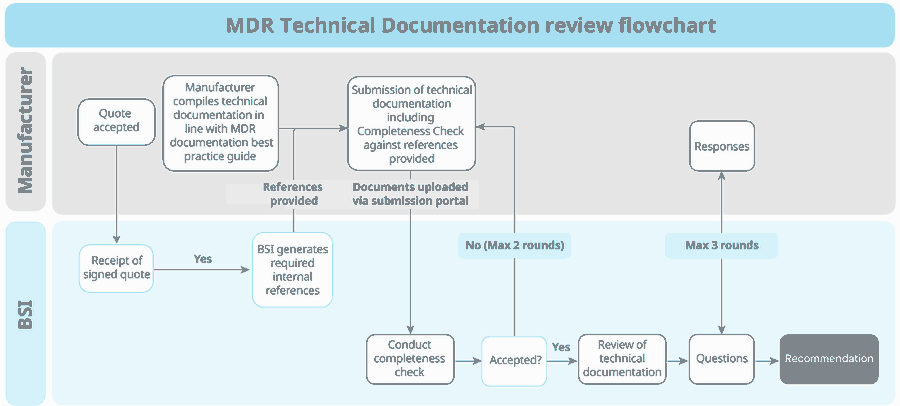
- Notify the Notified Body of your application (new clients usually via the sales team, existing clients via their Scheme Manager).
- For initial MDR work, obtain a formal quotation.
- Once the signed quote is received, the Notified Body assigns reference numbers. Quote them in every upload and email.
- Complete the MDR completeness check before the detailed review starts, so the first round of questions is not spent chasing missing documents.
- The conformity assessment is scheduled once the signed quote, all application documents and an accepted completeness checklist are in place.
Other factors that affect timelines

- Staff availability: make sure RA, QA, R&D and manufacturing experts are available during the review. The faster questions are answered, the faster they are closed.
- Working links: check that all hyperlinks, cross-references and embedded documents work and that every referenced document is included.
- Translations: have procedures to make sure labels, IFUs, marketing claims and Summaries of Safety and Clinical Performance (SSCPs) are translated accurately, because poor translation can affect safety.
- Certificate scope: new products or changes may fall outside your existing QMS certificate scope, which can trigger extra audits. Discuss with your Scheme Manager before submitting.
- Subcontractors and suppliers: report any changes. Critical suppliers without a valid ISO 13485 certificate from an EU Notified Body may need a verification audit.
- Accessories and compatible devices: describe each accessory, its classification and its documentation references, and show evidence of compatibility. Accessories outside your current QMS scope may need their own reviews.
Novel materials and technologies

New or high-risk materials, processes or indications may require extra expert consultations (toxicologists, statisticians, clinicians). Class III implantables and certain Class IIb active devices go through the EU clinical evaluation consultation procedure, and devices with medicinal substances or human/animal tissues may need regulatory consultations. These external steps can fall outside the standard review timescales, so plan for them early.
What to include: highlights from the technical file checklist
BSI’s guidance includes a detailed appendix listing what reviewers expect in each part of the file. The most important points are summarised below.
Device description and specifications

- Use the same product name and intended purpose consistently across every document, including the IFU, risk files, clinical evaluation, Declaration of Conformity and SSCP.
- Describe the design, principles of operation, mode of action, materials, single or multiple use and sterilisation method. Use labelled pictures and schematics.
- Explain how variants differ and why each still meets safety and performance requirements.
- Define the intended users, patient population, indications and contraindications, supported by evidence.
- Provide the Basic UDI-DI and EMDN code, plus a complete list of catalogue numbers, sizes and configurations covered.
- Give the classification and the rule applied, with justification.
Information supplied by the manufacturer

Include all labels (device, packaging, sterile barrier) and the IFU. Show traceability between the IFU content and each part of GSPR 23, and make sure warnings and residual risks match the risk management and clinical evaluation files. Where cybersecurity applies, follow the relevant MDCG guidance.
Design, manufacturing and GSPRs

Describe the design stages and the manufacturing processes, including sites and critical subcontractors with their ISO 13485 certificates. The GSPR checklist should state which requirements apply, which harmonised standards or Common Specifications were used, and point precisely to the controlled documents that prove conformity.
Benefit-risk analysis and risk management
Provide the risk management plan, procedures (including how risks are scored and accepted), the risk analysis and the report, aligned with EN ISO 14971. Show that controls such as process validation, biocompatibility, sterilisation and clinical data reduce risks as far as possible, and that the overall benefit-risk balance is acceptable.
Product verification and validation

- Biocompatibility: evaluation per the ISO 10993 series, or a justified gap assessment.
- Electrical safety and EMC: test reports for active devices.
- Software: a clause-by-clause checklist against EN 62304, with architecture, requirements, verification and cybersecurity documentation.
- Stability and shelf life: shelf life (storage before first use) is different from device lifetime, and testing should cover the device as well as the packaging.
- Performance and usability: design verification and validation data and usability engineering files.
- Clinical evaluation: a Clinical Evaluation Report is always required, with clinical data for every indication and variant. Class III and implantable devices also need an SSCP, reviewed at least annually.
- Post-market surveillance: the PMS plan, PMCF plan and reports, and Periodic Safety Update Reports (PSURs) where applicable.
- Special cases: sterilisation validation, packaging and transport validation, reprocessing of reusable devices, MRI safety, and devices containing medicinal substances, animal tissue or CMR/endocrine-disrupting substances.
Extra requirements for AI and machine learning devices

Devices that are or contain AI/ML models need additional documentation covering the whole model lifecycle:
- The AI system’s intended use, users and operating environment, and its lifecycle (for example per ISO/IEC 5338).
- Data sources and collection, cleaning and augmentation methods, labelling processes and labeller competence, dataset partitioning, features, size, and version control linking models to datasets.
- Hardware and software environments for training, testing and deployment, including known vulnerabilities of the libraries used.
- Training, testing and deployment methodology, including reproducibility, behaviour when inputs fall outside specification and how failures are detected.
- A change management plan for retraining and continuous learning, plus controls for feedback loops that could bias future predictions.
- AI-specific risk management, requirements, verification and transparency or explainability where applicable.
Key takeaways

- Submit a complete, stand-alone file and run the completeness check before the review starts.
- Use searchable, bookmarked PDFs, one per technical file part, with clear names.
- Keep the intended purpose consistent across every document.
- Flag scope changes, new suppliers, accessories and novel materials early.
- Have experts available to answer questions quickly during review.
A well-prepared technical file is the single most effective way to shorten the path to MDR certification. For the full guidance, reference documents and the latest MDCG guidance, see BSI Medical Devices.