


In an uncertain and complex market, business leaders are focused on agility, talent strategy and long-term growth. A professional employer organization (PEO) can be a strategic growth partner, taking on much of the HR administration that slows small and mid-sized businesses down so they can scale, compete and thrive.
But not all PEOs are the same, and the provider you choose makes a real difference. This guide covers three things to consider before you decide: how to evaluate providers, how to calculate the return on investment, and the benefits that go beyond the numbers.
1. Evaluating PEO providers

Accreditation and financial stability
- Is it certified? Accreditation from the IRS or the Employer Services Assurance Corporation (ESAC) shows that a provider meets rigorous financial, operational and ethical standards.
- Does it belong to an industry association? Membership in the National Association of Professional Employer Organizations (NAPEO) signals a commitment to best practices and professionalism.
- Is it financially transparent? Ask for third-party audit results and evidence of financial health. A good partner will be open about its business practices.
Employee benefits and administration
Will it enhance your benefits offering? Compare how well each PEO provides:
- Multiple coverage tiers of core benefits, including health, dental, vision and retirement plans.
- Ancillary benefits such as pet insurance, wellness programs and an employee assistance program (EAP).
- Flexible cost-sharing and employee contribution options that make benefits more affordable for both the business and its people.
Does it simplify benefits administration? Beyond sharing responsibility for managing benefits, look for technology and tailored guidance that save your team time.
Compliance
Does it help you keep up with laws and regulations? Constantly changing federal, state and local employment rules make compliance one of the hardest parts of HR management. According to Paychex, businesses spend $13,777 a week maintaining regulatory compliance.
Service-level agreement (SLA)
- Does the SLA provide clarity? It should ensure accountability, with clearly defined roles for the PEO and for your business.
- Are issues resolved promptly? Ask for real examples of how the PEO has handled service issues for its clients.
Scalability
Can the PEO grow with you? Make sure the provider is flexible enough not only to support growth, but to adapt as your needs and goals change.
2. Calculating the ROI of a PEO
More than 200,000 businesses outsource HR administration to PEOs, according to NAPEO. Here is how a PEO maps to some of the most common business challenges:
| Business challenge | Value of a PEO | Outcome |
|---|---|---|
| Increase productivity Businesses with 50+ employees spend 11+ hours a week on HR tasks. | Simplifies HR tasks such as employee benefits, payroll and workers’ compensation so you can focus on what matters most. | $1,775 per employee in average annual savings |
| Attract and retain employees Rated the most challenging HR task by businesses with 50–99 employees. | Offers Fortune 500-level benefits, such as health insurance, retirement plans and voluntary benefits, more affordably. | 7–9% faster growth for small businesses with a PEO |
| Maintain compliance Businesses spend 12+ hours a month complying with wage-and-hour and workplace safety laws. | Provides HR guidance on your specific issues, from compliance to payroll and benefits. | 30% of PEO clients save on workers’ compensation costs |
3. Benefits beyond the numbers
The financial case is compelling, but some of the most valuable outcomes don’t show up in an ROI calculation:
- Time saved on administration: leaders can focus on strategy, business development and customers instead of routine HR tasks.
- Lower legal risk and fewer penalties: the U.S. Department of Labor collected nearly $36 million in civil money penalties in 2024. Proactive guidance from HR professionals who track changing laws helps you avoid costly mistakes.
- Access to top talent: comprehensive benefits and professional HR support let smaller firms compete with larger employers.
- Better employee engagement: stronger benefits, smoother onboarding and responsive HR support create a better workplace experience and improve retention.
- Peace of mind: knowing experienced professionals are helping manage HR lets you focus on running the business.
Making the right choice for your business
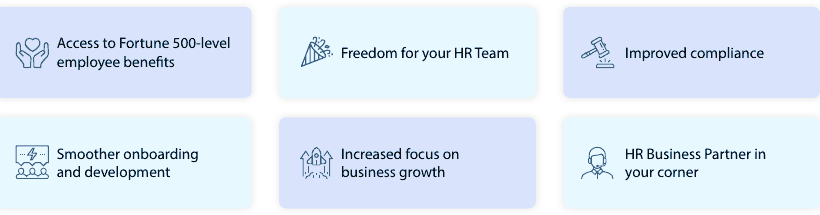
The right PEO can transform how your business operates, reduce costs and lift the employee experience. When you compare providers, look for accreditation, financial transparency, a strong benefits portfolio, clear service commitments and the ability to scale with you.
Paychex, which published the original guide, serves nearly 800,000 businesses and has 30 years of PEO experience supporting more than 2.5 million worksite employees. Its accredited PEO pairs each client with an HR Business Partner backed by specialists, along with HR technology designed to scale. Learn more at paychex.com/peo.